
Pauri Garhwal
Pauri Garhwal, a gem of Uttarakhand, offers a perfect blend of natural beauty and cultural charm. Among its many attractions is Chandrabani, a serene religious site known for its mythological significance and tranquil surroundings, attracting devotees and nature lovers alike.
Another must-visit is Lansdowne, a quaint hill station adorned with pine forests, colonial-era charm, and stunning views of the Himalayas, ideal for peaceful retreats and trekking enthusiasts. With its lush valleys, sacred rivers, and cultural richness, Pauri Garhwal promises an unforgettable journey for every traveller.
Offbeat Destinations in
Pauri Garhwal

Landsdowne
Lansdowne, a charming hill station nestled in the Himalayas at 1,700 meters, offers old-world colonial charm with its pines, oaks, churches, springs, and ponds, and is known for its salubrious climate, having been established in 1887 as a British cantonment and now serving as the headquarters of the Garhwal Rifles of the Indian Army.

Devalgarh
Devalgarh, a serene former capital of the Garhwal kingdom near Srinagar, is renowned for its ancient temples, including the Maa Raj Rajeshwari Devi temple, Laxmi Narayan temple, and Gauri Devi temple. These temples are set amidst lush greenery and offer mesmerising sunrises.
Khirsu
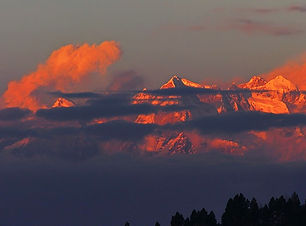
Khirsu, an idyllic and offbeat Himalayan village in the Pauri Garhwal district, offers a tranquil experience with its lush forests, apple orchards, and wildflowers. It also provides spectacular views of peaks like Panchachuli, Nanda Devi, Nanda Kot, and Trishul. Perched at 1,700 meters, it is a haven for nature walks, hikes, and agriculture, surrounded by dense pine and deodar forests and picturesque terrace farms.
Pauri Garhwal History
Pauri Garhwal's history reflects human civilisation's evolution in the Garhwal Himalayas, paralleling developments in the Indian subcontinent. The Katyuri dynasty was the first to rule a unified Uttarakhand, leaving a legacy of inscriptions and temples.
After the Katyuris’ decline, the region fragmented into over sixty-four principalities. Chandpurgarh, ruled by Kanakpal’s descendants, emerged as a major power.
Under Ajaypal in the late 15th century, these principalities were unified into the Garhwal Kingdom, with its capital eventually moved to Srinagar. Ajaypal and his successors ruled for nearly 300 years, facing invasions from other communities, both local and foreign. The Gorkha invasion in 1803 brought devastation, with Garhwal falling under their rule by 1804.
The British defeated the Gorkhas in 1815, taking control of the eastern half of Garhwal (‘British Garhwal’) while restoring the western region to King Sudershan Shah, who established his capital at Tehri.
Pauri became the headquarters of a separate district in 1840, marking a new administrative era. Pauri Garhwal’s history is a testament to resilience and transformation across centuries.